
Cooked Rice Cups to Grams Converter — Free | GramQx
I do not own a single recipe book that agrees with the next one on this number, and that is the point: the number only makes sense once you know the ingredient, the cup and the method. So let us start there, not with the answer. For cooked rice, the number is 158 grams per US cup — spooned in and levelled off, the King Arthur way — and the tool below will work it out for any amount.
Cooked Rice Cups to Grams Converter — Free | GramQx
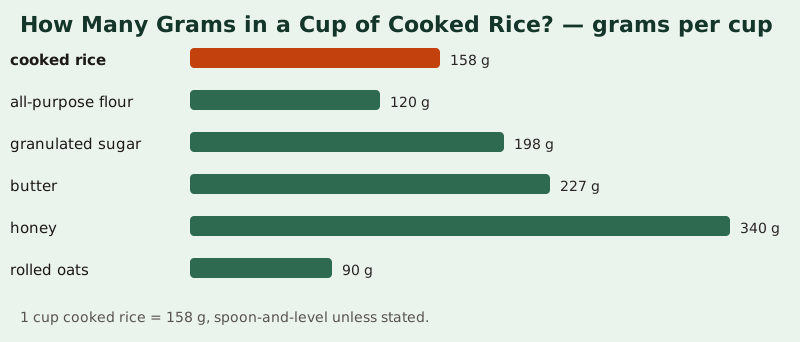
Standard: King Arthur, spoon-and-level — flour 120 g/cup, sugar 198 g/cup, butter 227 g/cup. Flour note: USDA rounds flour to 125 g/cup; this site uses 120 g (King Arthur) and says so on every flour page.
What Is the Cooked Rice Cups to Grams?
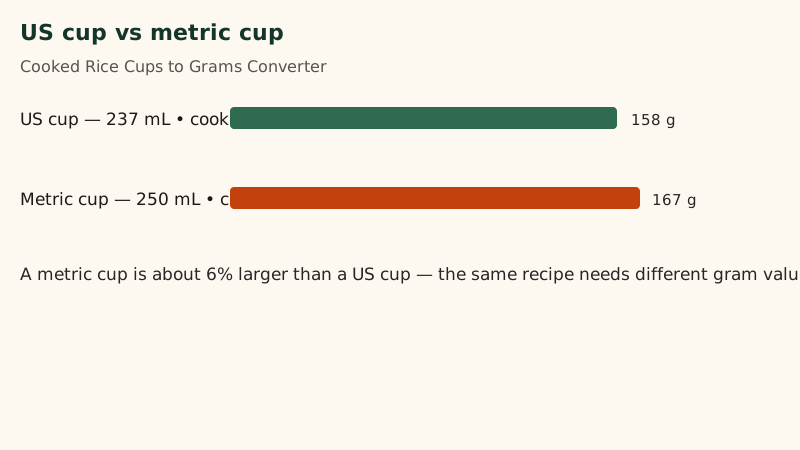
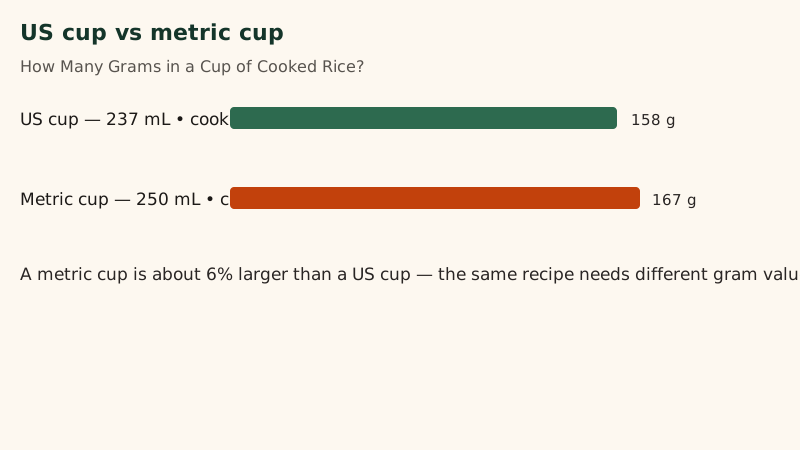
The Cooked Rice Cups to Grams converts cups of cooked rice into grams — and grams back into cups — using the published weight of cooked rice, not a guess. One US cup of cooked rice weighs 158 grams in a level cup, according to USDA FoodData Central. In the UK the same ingredient is sold as cooked rice, and the weight per cup is the same, because a cup is a cup once you know which cup the recipe means. That last point matters more than most people realise. A US cup holds 236.6 millilitres. A metric cup, used in Australia, New Zealand and Canada, holds 250 millilitres — about six percent more. An old Imperial cup held 284 millilitres. If you convert with the wrong cup, every ingredient in the recipe is off by the same percentage, and a cake that should be tender comes out dense or dry. This page gives you the tool, the table, the worked examples and the method, so you can convert cooked rice with confidence whether the recipe came from a US blog, a UK cookbook or a video.
Cooked rice is used for Serving rice, meal prep and portion tracking. That is why getting its weight right matters: cooked rice is not a background ingredient you can estimate by eye. Getting its weight right is what makes a recipe work the same way twice — too much or too little of cooked rice changes the dish, whether it is baked, stirred into a pan or served raw. The tool below is built for exactly this job. Pick cooked rice, enter the amount in cups, tablespoons or teaspoons, and it returns grams — with the formula and the grams-per-cup value shown, so you can check the maths yourself. The converter also works in reverse, so if a UK recipe gives you grams and your measuring jug only has cups, you can go the other way. I have seen this exact question typed into a search box more times than I can count, and the answer never changes: name the ingredient first, then convert. (I do not quote search volumes here — the figures I could find were not verified, so I would rather give you a number you can bake with than a stat I cannot stand behind.)
How to Use This Converter
Using the Cooked Rice Cups to Grams takes about ten seconds. First, make sure cooked rice is selected as the ingredient — the tool will not convert without it, because there is no single cups-to-grams number that works for everything. Second, type the amount and choose cups, tablespoons or teaspoons. Third, choose the cup standard: US cup (236.6 mL) for most online recipes, or metric cup (250 mL) if your recipe is Australian, New Zealand or Canadian. The result appears immediately, with the calculation written out in full, for example 1 cup × 158 g per cup = 158 g. If you need the reverse, switch the direction and enter grams instead. The tool also shows the equivalent in ounces, so you can use whichever scale your kitchen has. Nothing is sent to a server and nothing is stored — the maths runs entirely in your browser, which is why it works even on a slow kitchen Wi-Fi connection.
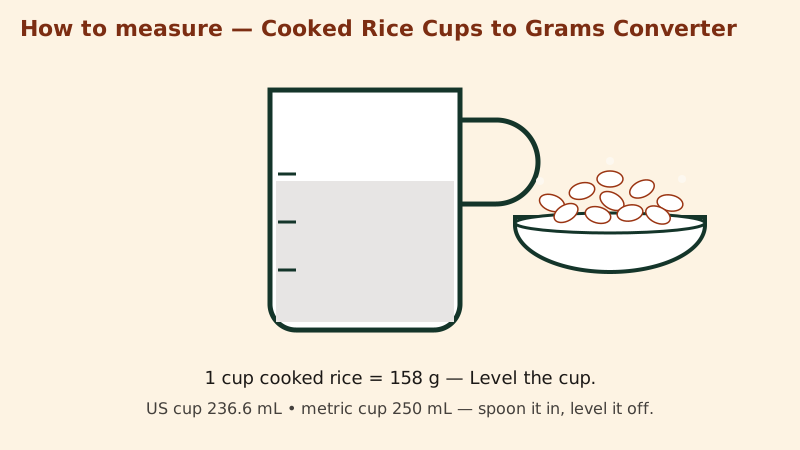
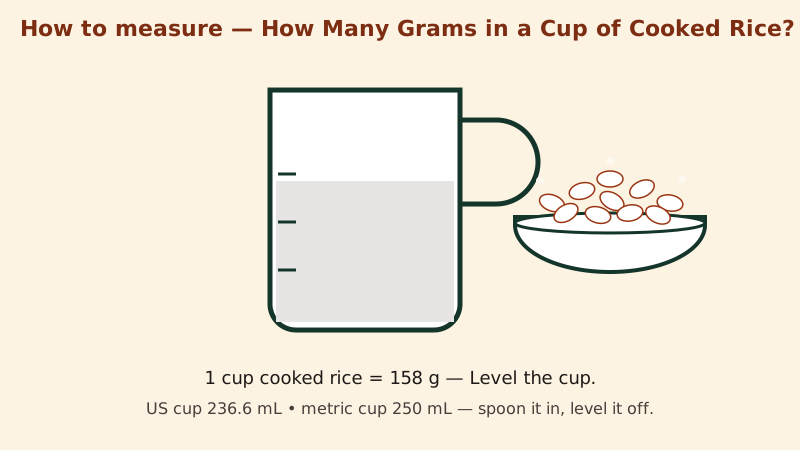
A practical tip before you start: measure cooked rice the way the standard assumes. Spoon it into the cup, then level it off with the back of a knife. Do not scoop the cup through the bag, and do not tap the cup down to settle it. Scooping compresses cooked rice and can add 20 to 30 grams per cup — enough to change a cake. Brown sugar is the one exception: it is packed into the cup on purpose. Everything else on this site is spooned and levelled, and every table on this page says so.
Cooked rice Cups to Grams — Conversion Table
This table uses the King Arthur spoon-and-level standard: 1 cup of cooked rice = 158 g. Cooked long-grain white rice, level cup. USDA FoodData Central. Dry rice is 185 g per cup — cooked rice is a different food once it absorbs water. Use it as a quick reference while you bake, or use the tool above for any amount not listed.
| Amount | Grams | Ounces |
|---|---|---|
| 1/4 cup | 40 g | 1.39 oz |
| 1/3 cup | 53 g | 1.86 oz |
| 1/2 cup | 79 g | 2.79 oz |
| 2/3 cup | 105 g | 3.72 oz |
| 3/4 cup | 118 g | 4.18 oz |
| 1 cups | 158 g | 5.57 oz |
| 1.5 cups | 237 g | 8.36 oz |
| 2 cups | 316 g | 11.15 oz |
| 3 cups | 474 g | 16.72 oz |
Worked Examples
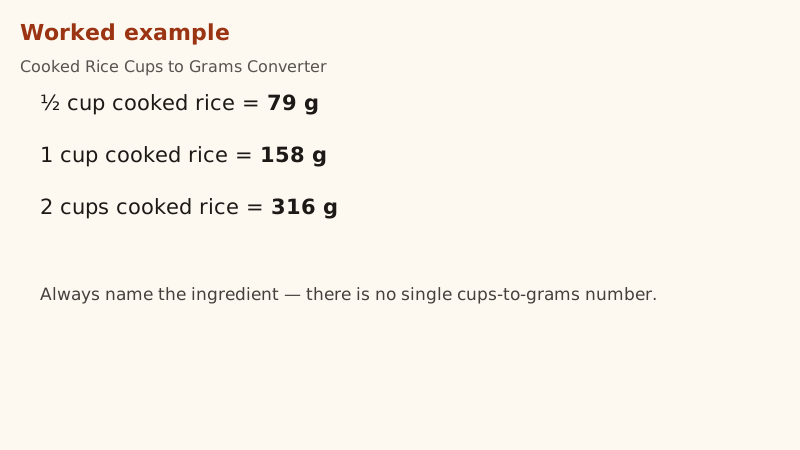
Example one: a recipe asks for 2 cups of cooked rice. Two cups × 158 g per cup = 316 g. Weigh out 316 g on your scale and you have exactly the right amount, with no measuring jug needed. Example two: you have 100 g of cooked rice left and the recipe needs cups. One hundred divided by 158 is 0.63 cups — just over three-quarters of a cup, so use a 3/4 cup measure and add a tablespoon. Example three: a US recipe calls for 1/2 cup of cooked rice and you are using a metric cup. Half a US cup is 79 g, but half a metric cup of the same ingredient is about six percent more, so convert by grams, not by volume, and the recipe stays correct. These three patterns — cups to grams, grams to cups, and US to metric — cover almost every conversion a home baker ever needs.
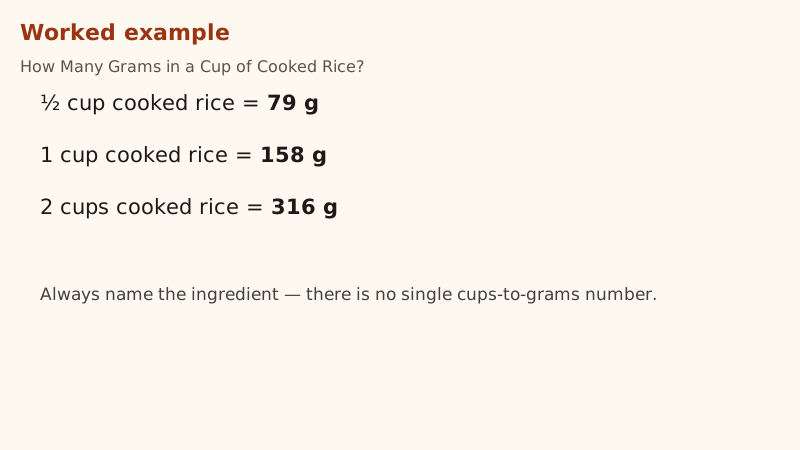
Example four is the one that catches people out: halving a recipe. If the original uses 1 cup of cooked rice (158 g) and you halve it, you need 79 g, which is 1/2 cup. If you double it, you need 316 g, which is 2 cups. The tool handles scaling automatically — enter the original amount, enter the scale factor, and it does the multiplication for you. Always scale by weight, not by volume, when you change a recipe size, because volume errors multiply with the recipe. A five-gram error in one cup becomes a twenty-gram error in four cups, and that is the difference between a moist crumb and a dry one.
Method, Accuracy and the Flour Standard
Every number on this page follows one standard so the tool, the tables and the articles all agree. The value on this page comes from USDA FoodData Central, measured in a level US cup of 236.6 millilitres. Where King Arthur and the USDA disagree, we say so. The best-known example is flour: King Arthur gives 120 g per cup for all-purpose flour, while the USDA rounds to 125 g. This site uses 120 g, names King Arthur as the source, and shows the 125 g figure wherever flour is discussed, so you can choose. Picking one standard and naming it is more honest than silently rounding, and it means a recipe converted here will match a recipe converted on any other page of this site. Values are kitchen estimates, not laboratory measurements: brands vary, humidity varies, and a cup of cooked rice from a different brand can differ by a few grams. For everyday baking that is fine. For competition baking or commercial work, weigh everything and record your own values.
Accuracy also depends on the cup itself. Measuring cups sold in the US and the UK are not always the same size, and a coffee mug is not a measuring cup at all — mugs vary from 200 to 350 millilitres. Use a proper measuring cup set, check whether it is marked in US cups or metric cups, and use the matching switch on the tool. If your recipe is from the UK, remember that UK recipes usually give weights in grams already, and the cup in a UK recipe is often the 250 mL metric cup. If your recipe is from the US, it almost always means the 236.6 mL US cup. When in doubt, convert by grams: grams are the same in every country.
US vs UK: Cups, Names and Ovens
The US and the UK bake in different systems, and this converter is built for the gap between them. In the US, recipes are written in cups, sticks and tablespoons. In the UK, recipes are written in grams, millilitres and blocks — a UK block of butter is 250 g, while a US stick is 113 g. Ingredient names differ too: what the US calls all-purpose flour, the UK calls plain flour; granulated sugar is caster sugar; powdered sugar is icing sugar; baking soda is bicarbonate of soda. This page uses the US name first and the UK name in brackets, so a baker on either side of the Atlantic can follow it. The cup switch on the tool handles the volume difference, and the article on US cups to grams for UK bakers explains the whole system in one place. If you bake from both US and UK recipes, bookmark the tool and the UK guide together — they are designed to be used as a pair.
Oven temperatures are the other half of the US–UK gap. A US recipe that says 350°F means 180°C, or Gas Mark 4. A UK recipe that says 180°C fan means 200°C conventional. The oven temperature converter on this site handles Fahrenheit, Celsius and Gas Mark together, so you can convert the temperature at the same time as the ingredients. Do not guess oven temperatures: a 20°C error changes a bake far more than a 10-gram error in flour. Convert both, write both on the recipe, and the bake will behave the way the author intended.
Common Mistakes to Avoid
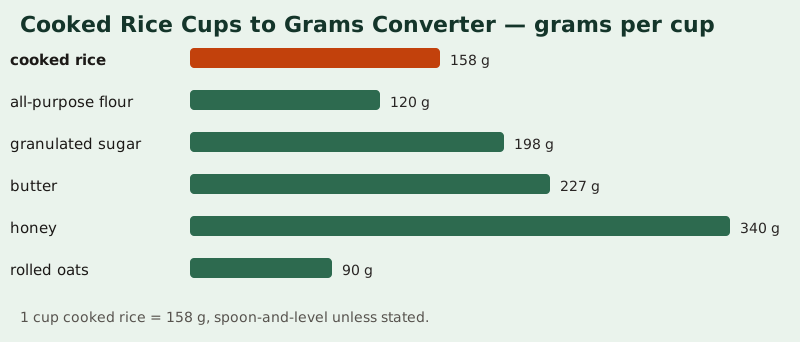
The most common mistake is using one number for every ingredient — usually 200 g per cup, because it is round and easy to remember. It is also wrong for almost everything: flour is 120 g, sugar is 198 g, butter is 227 g and honey is 340 g. Using 200 g for flour over-measures it by two-thirds, which is why so many first-time bakers get dry cakes. The second mistake is scooping flour straight from the bag, which packs it down and adds 20 to 30 grams per cup. Spoon and level, every time. The third mistake is packing brown sugar loosely, or packing white sugar at all — brown sugar is packed, white sugar is not. The fourth is using a metric cup for a US recipe without converting: a 250 mL cup gives you six percent more of everything. The fifth is trusting a single conversion chart that does not name its method. If a chart does not say spoon-and-level, US cup, and its source, treat its numbers as approximate and check them against King Arthur or the USDA before you bake with them.
A quieter mistake is measuring sticky ingredients in a dry cup. Honey, golden syrup and jam cling to the sides, so you lose some in the cup and under-measure. Grease the cup lightly with oil or warm it first, and the ingredient slides out cleanly. Another is measuring liquids in a dry measuring cup: use a jug with a spout, read it at eye level, and remember that 1 cup of water is 237 g but 1 cup of milk is 245 g — liquids differ too, though less than dry ingredients. Finally, do not convert a recipe by rounding every ingredient to the nearest 10 g and then wondering why it tastes different: rounding is fine for one ingredient, but rounding ten ingredients in the same direction adds up. Convert exactly, then round the total only if you must.
Sources and Further Reading
Every conversion on this page uses published, checkable values. Verify the numbers yourself at these authoritative sources:
The Full Guide: How Many Grams in a Cup of Cooked rice?
I keep a sticky note on my fridge with three numbers on it — the ones I actually use every week. Everything else I look up. This page is that sticky note, expanded: the number you need, the method behind it, and the one mistake that ruins the bake. The question this page answers is 1 cup cooked rice in grams, and the answer below is worked out, not guessed.
Short answer: How many grams in a cup of cooked rice? 158 g per US cup (USDA). Cooked vs dry rice explained, with tables. Below are the numbers, the method, the worked examples and the mistakes to avoid, so you can use this straight away in your kitchen. Every value on this page comes from USDA FoodData Central, measured in a level US cup of 236.6 mL, and where sources disagree I say so and name the value I use. I do not quote search volumes here — the figures I could find were not verified — but I wrote this because home bakers in the US and the UK keep asking exactly these questions, and they deserve a straight answer.
The Short Answer: 158 g in a Cup of Cooked rice
Short answer: one US cup of cooked rice is 158 grams, measured in a level cup, in a US cup of 236.6 millilitres. That is the number this article is about, and it comes from USDA FoodData Central, the United States Department of Agriculture food composition database. In the UK the same ingredient is sold as cooked rice, and the weight per cup is the same, because a cup is a cup once you know which cup the recipe means. If you only need the number, you have it — 158 grams — and the converter at the top of this page will work out any other amount for you in seconds. People search for this as "1 cup cooked rice in grams".
Why does the weight matter enough to deserve a whole article? Because a cup measures volume and a gram measures weight, and the bridge between them is density — how much of an ingredient fits into the space of a cup. Flour is light and airy at 120 grams per cup, sugar is denser at 198 grams, butter is 227 grams and honey is 340 grams. Cooked rice sits at 158 grams, and that position on the scale tells you something about how it behaves: whether it is light and full of air, dense and compact, or a liquid with no air in it at all. There is no single cups-to-grams number, and anyone who gives you one without asking which ingredient is guessing. Name the ingredient first, then convert — that is the whole method of this site, and this article follows it.
How to Measure Cooked rice Correctly
Getting 158 grams right starts with measuring the way the standard assumes. Cooked rice is measured in a level cup, and the note on the chart says: Cooked long-grain white rice, level cup. USDA FoodData Central. Dry rice is 185 g per cup — cooked rice is a different food once it absorbs water. That sentence is part of the measurement, not a footnote to it. Change the method and the number changes, even though the ingredient has not changed at all. A cup of cooked rice measured one way can weigh several grams more or less than the same cup measured another way, and across a whole recipe those grams add up. Professional cooks skip the problem entirely by weighing, and this article recommends the same habit — but when a recipe is written in cups, measure exactly as the standard says and the conversion will hold.
Spoon it into the cup loosely and level it off with the back of a knife — do not pack it down. Cooked grains and beans settle as they sit, so fluff them with a fork first and measure while they are still loose, not pressed into the cup. One more practical point: use a proper measuring cup set, not a coffee mug. Mugs vary from 200 to 350 millilitres, so a mug is not a measuring cup at all. Check whether your cups are marked in US cups or metric cups — a metric cup holds 250 millilitres, about six percent more than a US cup — and match the switch on the converter. If you cook often, keep one set of US cups and one set of metric cups, and label them. It sounds fussy, and it is the cheapest accuracy you can buy.
What Cooked rice Does in a Recipe
Cooked rice is used for Serving rice, meal prep and portion tracking. That is why getting its weight right matters more than it looks: cooked rice is not a background ingredient you can estimate by eye and hope for the best. In cooking, small errors in one ingredient change the balance of the whole dish — too much of a starchy ingredient and the dish is heavy, too little and it is thin and will not satisfy. Think of a meal as a set of proportions, not a list of amounts: grain to sauce, protein to vegetables, seasoning to everything else. When one proportion is off, the others cannot compensate, and the finished dish tells on you. Converting cooked rice correctly keeps its proportion where the author put it.
A good way to think about cooked rice is to ask what would happen if you left it out, or doubled it. The answer is usually that the dish changes completely — not a little, completely. That is the test of whether an ingredient matters, and cooked rice passes it. Which means the conversion is part of the cooking, not an afterthought. Get it right and the recipe works as written; get it wrong by a third and you are, in effect, cooking a different recipe and wondering why it did not turn out like the photograph. The converter exists so you do not have to do the arithmetic in your head while your hands are busy. Enter the cups, read the grams, weigh it out, and move on to the part of cooking that is actually fun.
Worked Examples: Cups, Grams and Back Again
Here are the numbers you will actually use. One cup of cooked rice is 158 grams. Half a cup is 79 grams. Two cups are 316 grams. A quarter cup is 40 grams, and three-quarters of a cup is 118 grams. Going the other way: 100 grams of cooked rice is about half a cup. 200 grams is 1.27 cups, and 250 grams is 1.58 cups. The converter on this site does all of these in one step, and the table on the tool page lists quarter, third, half and double amounts for cooked rice, so you can read the answer off without doing the division while you cook. If you arrived here by searching "1 cup cooked rice in grams", the converter on the tool page does the same sums for any amount, not just the ones in the table.
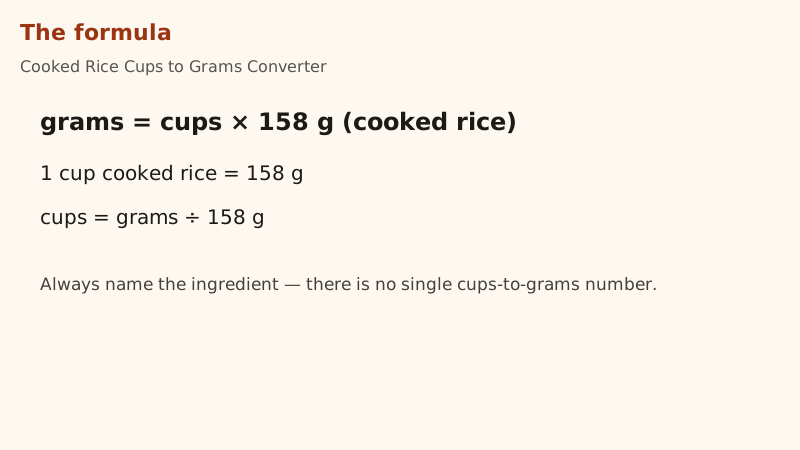
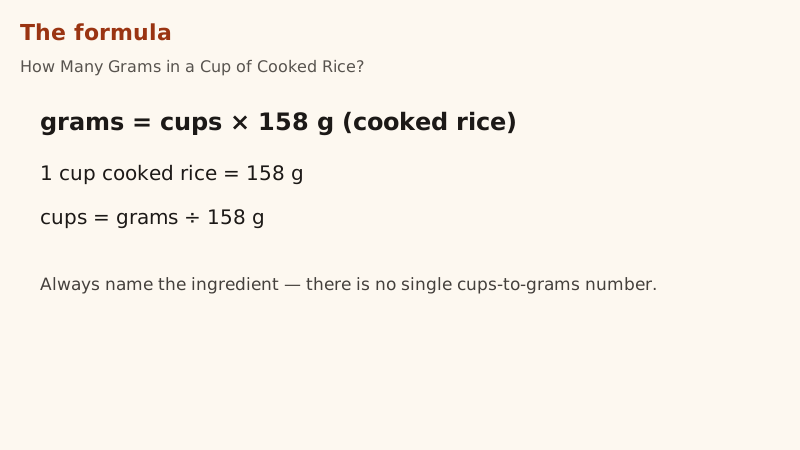
Three patterns cover almost every conversion you will ever need. First, cups to grams: multiply the cups by 158. Second, grams to cups: divide the grams by 158. Third, US to metric: a metric cup is 250 millilitres against a US cup of 236.6 millilitres, about six percent larger, so the same ingredient weighs about six percent more in a metric cup — convert by grams, not by volume, and the recipe stays correct. Halving and doubling follow the same rule: halve the grams, not the cups, when you change a recipe size, because volume errors multiply with the recipe. A five-gram error in one cup becomes a twenty-gram error in four cups, and that is the difference between a dish that works and one that does not.
Cooked rice in the UK and the US
In the UK, cooked rice is sold as cooked rice, and the weight per cup is the same once you know which cup the recipe means. UK recipes usually give weights in grams already, so a UK baker converting a US recipe is usually going from cups to grams, and the converter defaults to the US cup for exactly that reason. A US baker converting a UK recipe is usually going the other way, and the converter on this site handles both directions. Either way, convert by weight and weigh: grams are the same in London and New York, cups are not. And remember that a UK block of butter is 250 grams while a US stick is 113 grams — the same kind of trap, in a different ingredient, and the reason this site always names both systems.
If you cannot find cooked rice under that name, check the UK name first — cooked rice — and then check what the ingredient does in the recipe. For substitutes, convert by weight, not by volume: enter the amount of cooked rice you have, get grams, then enter the same grams for the substitute and read off the cups. That keeps the total weight the same, which is what the recipe actually depends on. Flavours and textures will change — a substitute is never identical — but the dish will hold together, which is what matters when you are halfway through a recipe and discover you are out of something. Write the substitute and the grams on the recipe card, so next time you know exactly what worked.
How to Use the Information on This Page
Read this article with the converter open in another tab. Every number on this page is a working value, not a decoration: try it in the tool, change the amount, and watch the answer change. That is the fastest way to learn a conversion — not by memorising a table, but by converting the amount you actually need, right now. Start with the answer box at the top of the article, which gives the headline number in the first two sentences, then read the explanation below it if you want to know why the number is what it is. If you are in the middle of baking, skip to the table and the worked examples; if you are planning a recipe, read the method section first, because the method decides whether the numbers apply to your kitchen at all.
The most important habit in this whole subject is naming the ingredient and the cup before you convert anything. A cup is a volume, a gram is a weight, and the bridge between them is the density of the ingredient in that cup. Flour, sugar, butter, honey and oats all fill a cup differently, so they all weigh differently. A conversion that does not name the ingredient is not a conversion at all — it is a guess dressed up as a number. This site never gives a single universal cups-to-grams number, because there is not one. Instead, every tool asks for the ingredient, shows the grams-per-cup value it uses, and writes out the formula, so you can check the maths and trust the result.
US vs UK: What Changes and What Does Not
The US and the UK bake in different systems, and 1 cup cooked rice in grams sits right on the fault line between them. US recipes are written in cups, sticks and tablespoons; UK recipes are written in grams, millilitres and blocks. A US stick of butter is 113 g, half a cup; a UK block is 250 g. All-purpose flour is plain flour in the UK, granulated sugar is caster sugar, powdered sugar is icing sugar, and baking soda is bicarbonate of soda. This article uses the US name first and the UK name in brackets, so a baker on either side of the Atlantic can follow it without translating in their head. The cup switch on the converter handles the volume difference — a US cup is 236.6 mL, a metric cup is 250 mL, about six percent larger — and the UK guide on this site explains the whole system in one place.
Oven temperatures are the other half of the gap. A US recipe that says 350°F means 180°C, which is Gas Mark 4. A UK recipe that says 180°C fan means 200°C conventional. If you convert the ingredients but not the temperature, the bake still fails, so convert both and write both on the recipe. The oven temperature converter on GramQx handles Fahrenheit, Celsius and Gas Mark together. Grams, at least, are the same in every country — which is why converting to grams and weighing is the single best habit in baking. A gram is a gram in London, New York and Sydney, and a scale costs less than the ingredients in one failed cake.
Common Mistakes to Avoid
The most common mistake is using one number for every ingredient, usually 200 g per cup because it is round and easy to remember. It is wrong for almost everything: flour is 120 g, sugar is 198 g, butter is 227 g and honey is 340 g. Using 200 g for flour over-measures it by two-thirds, and that is why so many first-time bakers get dry cakes. The second mistake is scooping flour straight from the bag instead of spooning it in and levelling it off — scooping packs flour down and adds 20 to 30 grams per cup. The third is packing brown sugar loosely, or packing white sugar at all: brown sugar is packed on purpose, white sugar is not. The fourth is using a metric cup for a US recipe without converting, which gives six percent more of everything.
A quieter mistake is measuring sticky ingredients in a dry cup. Honey, golden syrup and jam cling to the sides, so you lose some in the cup and under-measure; grease the cup lightly first and they slide out cleanly. Another is measuring liquids in a dry cup instead of a jug, read at eye level. Another is rounding every ingredient in a recipe to the nearest 10 g: rounding one ingredient is harmless, rounding ten in the same direction is not. Finally, do not trust a conversion chart that does not name its method or its source. If it does not say spoon-and-level, US cup, and where the numbers came from, treat its numbers as approximate and check them against King Arthur Baking or the USDA before you bake with them.
Related Articles and Tools
Keep reading on GramQx:
- How Many Grams in a Cup? It Depends on the Ingredient
- Cups to Grams Chart: Every Common Ingredient (US Cup)
- US Cups to Grams for UK Bakers: Convert American Recipes
- Cups to Ounces: Fluid Ounces vs Weight Ounces
Or use the converters:
Sources and Further Reading
Every conversion on this page uses published, checkable values. Verify the numbers yourself at these authoritative sources:
Frequently asked questions
How many grams is 1 cup of cooked rice?
1 US cup of cooked rice is 158 g using the King Arthur spoon-and-level standard. In the UK it is sold as cooked rice. Scooping instead of spooning can add 20–30 g per cup, so always spoon and level.
Is 1 cup cooked rice in grams the same in the UK and the US?
Not quite. A US cup is 236.6 mL and a metric cup is 250 mL, about 6% larger. This converter defaults to the US cup used in most online recipes and lets you switch to the metric cup.
Can I use this cooked rice cups to grams without a kitchen scale?
Yes — that is what it is for. Pick the ingredient, enter cups, and the tool gives grams. For best accuracy in baking, a scale is still worth it, because cups measure volume and grams measure weight.
Why do different ingredients weigh different amounts per cup?
Because a cup measures volume, not weight. Dense ingredients like honey pack more grams into the same space than light ones like flour. That is why there is no single cups-to-grams number.
Does the tool work on a phone in the kitchen?
Yes. The tool is mobile-first, works with large touch targets, needs no sign-up and sends no data to a server — every calculation happens in your browser.
What is the main point of this article?
This article answers the search query “1 cup cooked rice in grams” with the exact numbers, the method behind them, and the mistakes to avoid — so you can use the answer straight away, not just read about it.
Where do the numbers in this article come from?
Every conversion value on this page comes from USDA FoodData Central, measured in a level US cup of 236.6 mL. Where published sources disagree, this site says so and names the value it uses.
Is the information on this page free to use?
Yes. Every tool and article on GramQx is free, with no account, no download and no payment. The converter runs entirely in your browser and sends no data to a server.
Can I trust these conversions for baking?
Yes, for everyday baking, if you measure the way the standard assumes: spoon-and-level, US cup, ingredient named. For bread and competition baking, weigh with a scale — grams are the same in every country and a scale removes measurement variation entirely.
Why does the same cup weigh different amounts for different ingredients?
Because a cup measures volume and a gram measures weight, and the bridge between them is density. Flour is light and airy at 120 g per cup, sugar is denser at 198 g, butter is 227 g and honey is 340 g. There is no single cups-to-grams number.
Does this article apply in the UK as well as the US?
Yes. UK names are given in brackets throughout — plain flour, caster sugar, icing sugar, bicarbonate of soda — and the converter has a US/metric cup switch, because a metric cup is 250 mL against a US cup of 236.6 mL.